![CNMSOC_Logo [Colour].png](https://static.wixstatic.com/media/0e0c20_2df323558d9441b885515f429d67843e~mv2.png/v1/fill/w_51,h_51,al_c,q_85,usm_0.66_1.00_0.01,enc_avif,quality_auto/CNMSOC_Logo%20%5BColour%5D.png)
We Are Arriving At: Museum
- Minghao
- Apr 26
- 7 min read
How many times have you bypassed the Museum stop and seen these two fellas standing in front of the LKCNHM sign? How many times have you actually stepped inside the museum and had a look at the exhibits? Let me bring you into the Lee Kong Chian Natural History Museum and show you some interesting exhibits!

The story of Wallace
So who are these two fellas? They are Wallace and Ali. The British naturalist Alfred Russel Wallace arrived in Singapore in 1854. He spent a total of 228 days in Singapore and utilised Singapore as a base for collecting specimens. Ali, a young Malay man, was originally hired by Wallace as a cook. Over time, he became highly skilled in collecting specimens and helped Wallace collect thousands of specimens. He was not just a servant, but the “most trusted assistant” who was crucial to Wallace’s success. This statue was crafted by students from NAFA. If you look at the direction Wallace is pointing towards, you can find a bird — probably Wallace was asking Ali to hunt that bird!
Another interesting story about Wallace is his relationship with Charles Darwin. Without Wallace, Darwin might not have published his groundbreaking work, On the Origin of Species. Darwin had been working on evolution for over 20 years, yet he had not published anything. He was afraid of controversy. In his time, Christianity was the dominant belief, and most people believed that species were created by God. Publishing such a “radical” theory might have damaged his reputation or caused isolation. It was only until one day when he opened a letter sent from Singapore that he realised that he was not alone — he and Wallace discovered the same theory independently. That was what prompted Darwin to publish this theory of natural selection after two decades of gestation and hesitation.
Rafflesia

What a giant flower! If you have been to Malaysia and used ringgit notes before, you might have noticed it on the RM10 banknote. It is called Rafflesia. It was named after Stamford Raffles who discovered this unique flower.
Here are some reasons why it is so unique. It is the largest single flower in the world. In some species, such as Rafflesia arnoldii, the flower may be over 1 metre in diameter and weigh up to 10 kilograms. In comparison, a typical jasmine flower is only 2.5 centimetres in diameter, and you probably won’t even feel its weight when holding one in your hand. Rafflesia is a completely parasitic plant. It has no root, no leaf, no stem. It steals water and nutrients from its host plant.
It is famous for its strong rotting smell. But if you actually see one in the wild, the smell might actually not be that dramatic as expected. Not all species have equally strong odours, and the smell depends on the time and weather. Furthermore, the smell is designed to attract insects like flies, so what might be strong for flies might not be so noticeable for humans.
Diplodocids

Here comes the most exciting exhibit of the museum, dinosaurs! The three diplodocids were discovered in the US, and the fossils were 80% complete, which was quite rare. The biggest one, which was named “Prince” is approximately 27 metres long, and it is possibly a male. The slightly smaller one was named Apollonia and is possibly a female. These three diplodocids were discovered at the same place, so they might be a family. However, it still remains a guess because it is difficult to prove it scientifically.
There is also an interactive section where you can touch a real dinosaur bone!

Sperm Whale

This sperm whale was discovered on the coast of Singapore in 2015. It ran aground and died because of the fracture on its tail bone — the part where it is lit up is where it got injured. It is suspected that it was hit by the propeller of a boat. When the scientists dissected it, they found many plastic wastes in its stomach.
Narwhal

If you believe the myth of unicorns, you’ll have to check this out. Narwhal is often regarded as the unicorn of the sea because of its unique long tusk. This tusk measures 2.7 metres long. It was donated to the museum in 2015 in honour of Singapore’s 50 years of independence. The donors, Hoo Miew Oon and Hoo Mui Han were the great-granddaughters of Hoo Ah Kay who was better known as Whampoa. The tusk was gifted to Whampoa by the Russian government and it survived World War II as his son carefully hid it. Symbolising the legend of Whampoa’s family and the patriotism of Singaporeans, it is now proudly standing in the museum and narrating the story of a Singaporean family to every visitor.
Mouse Deer

Mouse deer are the smallest animals with hooves. There is a famous founding legend of Malacca about this little creature. A prince from Sumatra, who later became the founder of Malacca, arrived at a riverbank while he was fleeing from enemies. As he rested under a tree, he saw his hunting dog chase a small animal, which is usually described as a mouse deer. Instead of running away, the tiny moue fought back and kicked the dog, sending it into the river. He was impressed and thought that if even a tiny mouse could defeat his dog, this place must possess extraordinary strength and spirit. See it as a good omen, he decided to settle here and founded a kingdom, Malacca.
Saltwater Crocodile

This saltwater crocodile is a great role model for all workaholics. It used to “work” in the Singapore Zoo and died in 2007, aged approximately 40 years. It was then donated to the museum, and it now continues to “work like a dog” in its afterlife. It is such a competitive world, even animals have to work overtime, or in this case, “overlife”.
The saltwater crocodile holds the record for the most powerful bite of any living animal. Adult males can exert a bite force of around 16,000 newtons, far stronger than lions or great white sharks. What does 16,000 mean? Well, a strong gym-goer might bench press 150 kilograms. You’ll know how hard you’ll have to train to achieve this if you are a gym-goer. A saltwater crocodile’s bite is about 10 times its weight! Although the crocodiles are native to Singapore and they still exist today, there is so far no recorded crocodile attack in recent decades, so don’t worry, we are co-existing well with these scary animals.
Spider Crabs

How many crabs can you spot in this picture?
Are there 4 crabs?
No, there are 5 crabs in the picture. Let’s zoom in and have a look at the fifth one.

The giant crab is called the Japanese spider crab, and it has the greatest leg span of any known arthropod, reaching up to 3.7 metres from claw to claw. The almost invisible crab is the coral spider crab, and this species rarely exceeds 2 millimetres in body length. The giant Japanese spider crab is almost 2,000 times bigger than this tiny coral spider crab! This coral spider crab species actually exists in Singapore, around the Labrador Reserve and the Sentosa area. Good luck spotting one when you hit the beach!
Horseshoe Crabs
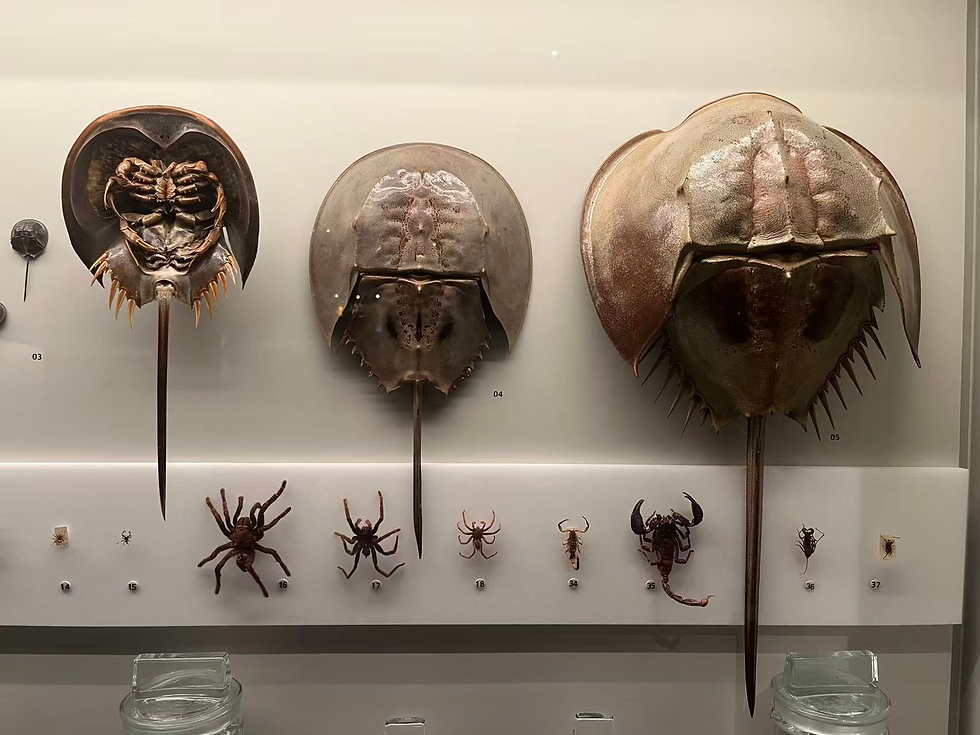
Not a true crab, but it is called a horseshoe crab. Having witnessed the rise and fall of the dinosaur dynasty, it is often called a “living fossil”. The most unique feature is its blood. Its blood is blue due to copper-based liquid. The blood is extremely valuable in medicine as it is a good indicator of bacterial toxins. It is used globally to test vaccines, intravenous drugs and medical equipment contamination.
However, being medicinally valuable is usually not good news to the animal. Collecting blood usually involves bleeding live horseshoe crabs, which weakens or even kills them afterwards. Hence, scientists came up with a synthetic alternative that could reduce the use of real horseshoe crab blood. This breakthrough happened at NUS! You can find the researchers’ (Ding Jeak Ling and Ho Bow) papers on the NUS Library portal!
Leatherback Sea Turtle

If you ever have a chance to touch this giant sea turtle, you’ll probably come up with the same name as the scientists did — leatherback sea turtle. Unlike other sea turtles, its back literally feels like leather. It is the largest species of all living turtles and the heaviest non-crocodilian reptile. There is a tale saying that a giant sea turtle saved a prince who capsized and was close to drowning. And if you imagine a turtle that was big enough to help a human to stay afloat, it would most likely be a leatherback sea turtle.
Unfortunately, sea turtles are greatly affected by climate change. The sex of sea turtles is determined by incubation temperature. Global warming causes more females and fewer males to be produced. This skewed sex ratio poses a great threat to the reproduction of sea turtles.
Black Marlin

If you have read Hemingway’s The Old Man and the Sea, this fish might ring a bell. It is a marlin, the fish that the old fisherman had a long struggle with. The marlin exhibited in the museum is a black marlin, one of the fastest fish in the world. It can swim up to 130 kilometres per hour! This specimen was stranded at the beach at East Coast Park, and it weighed 245 kilograms when it was found! No wonder the old fisherman was so desperate to catch that fish!
Here comes another classic Singapore legend. In ancient Singapore, the coast was attacked by schools of swordfish (which is not exactly marlin, but they are both billfish). They impaled people, causing deaths and panic. The ruler failed to overcome the swordfish crisis to protect his people. A young boy suggested using banana tree trunks to build a barricade along the shore. The swordfish became trapped and the attack was stopped. However, the king became jealous of boy’s intelligence, scared that the boy might one day challenge his authority. Hence, he sent his men to kill the boy. His blood flowed down and stained the entire hill. Today, the hill is known as Bukit Merah or Redhill which remains as a memorial to the boy who saved villagers’ lives but cost him his own.
After reading all these facts and interesting stories, are you interested to visit the museum one day? It opens on Tuesdays to Sundays, 10am to 6pm, and NUS students can enjoy free admission! So next time when you hear the announcement “We are arriving at: Museum”, be ready to get off the bus!


Comments